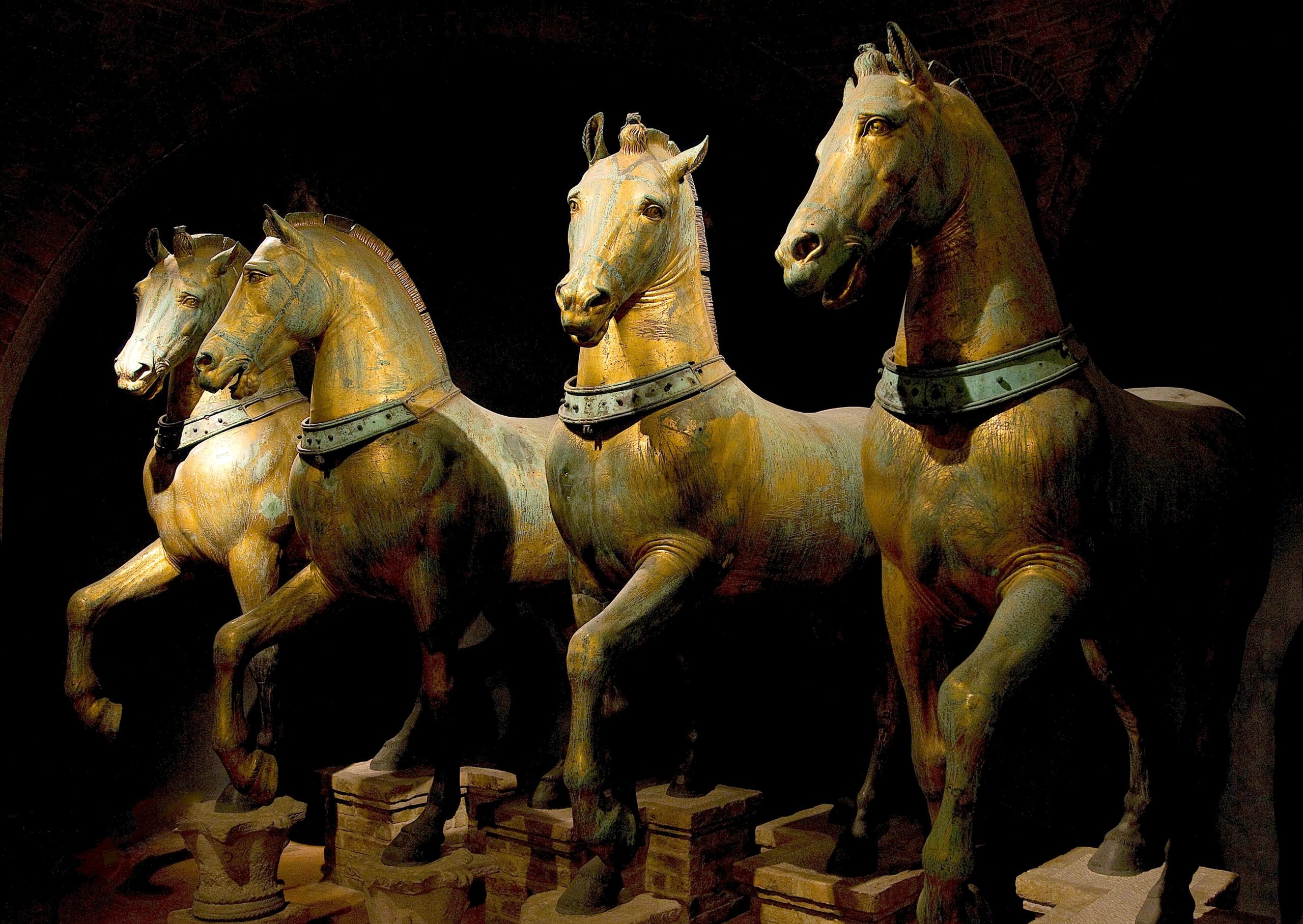
Original Horses inside Basilica San Marco
They have stood above the central portal of St. Mark’s Basilica for centuries, gazing over the piazza as empires rose and fell. The Horses of St. Mark, four monumental bronze steeds once harnessed as a quadriga, are among the most contested and symbolically charged works of art in Europe. For the Republic of Venice, they were a strong statement.
Believed to date from classical antiquity, the horses are widely attributed to the Hellenistic world, though their precise origin remains debated. Some scholars place them in the 4th century BCE; others suggest a later Roman casting. They may have been made probably for Constantinople, to crown the Hippodrome as an imperial emblem of triumph.
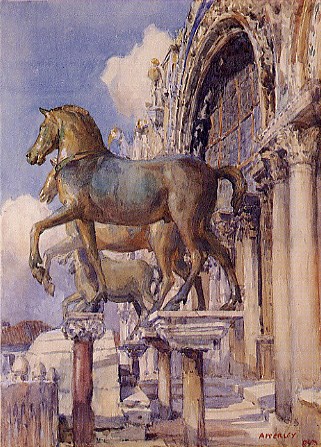
From Constantinople to the Republic of Venice
In 1204, during the Fourth Crusade, Venetian forces diverted from their original mission and sacked Constantinople. Among the spoils transported across the Adriatic were the four bronze horses. Installed on the façade of St. Mark’s Basilica, they became trophies of conquest, and visual shorthand for the expanding reach of the Republic of Venice.
The decision to mount the quadriga above the basilica’s central arch was calculated. St. Mark’s was both a religious sanctuary and the ceremonial heart of the state. By placing the horses there, Venice fused sacred authority with maritime dominance. The Republic of Venice was not simply a trading power; it was an inheritor of Rome and Byzantium.
The horses’ posture: muscular necks arched, nostrils flared, evokes forward motion, even when stationary. In antiquity, quadriga sculptures crowned triumphal monuments, reinforcing the imagery of victorious rulers. Venice adapted that iconography for itself. The message was unmistakable: the Republic of Venice had arrived as a Mediterranean superpower.
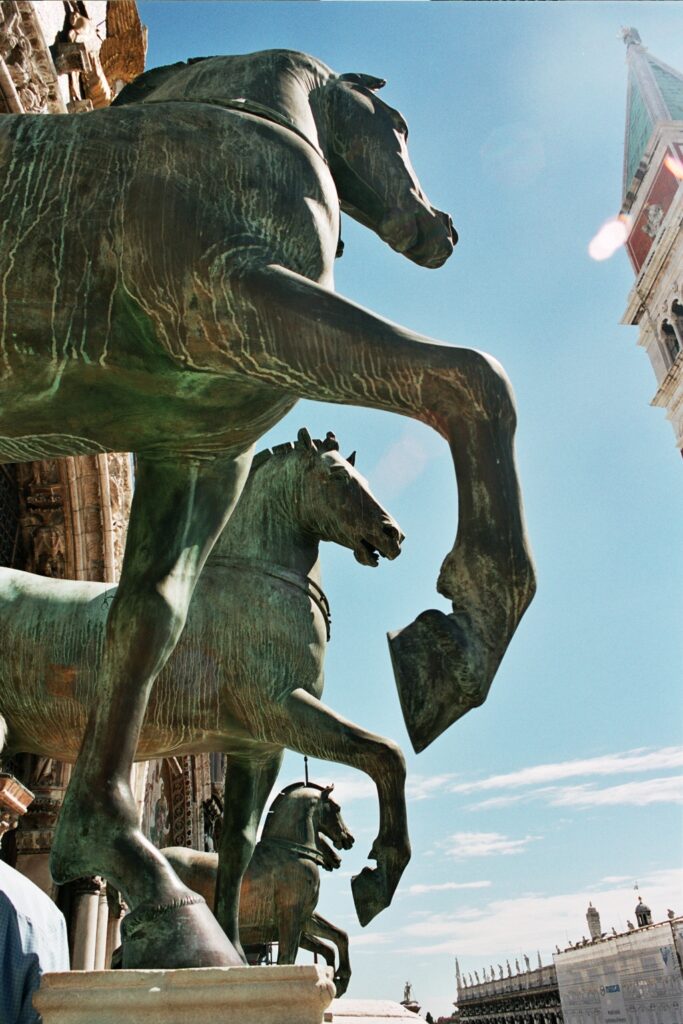
Napoleon’s Seizure and the Return
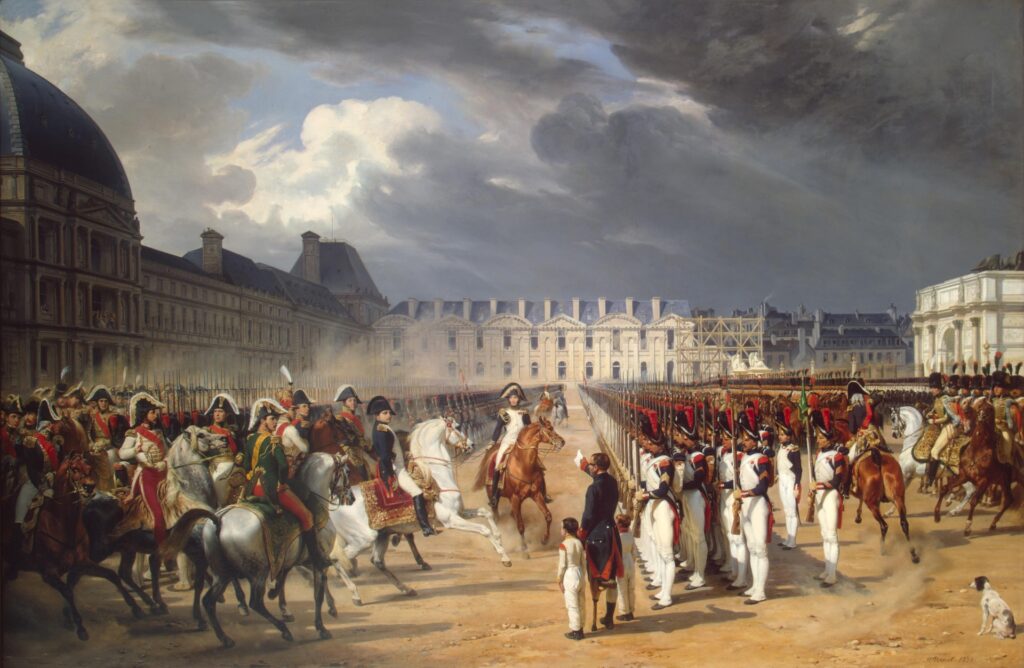
The horses did not remain untouched by later ambitions. In 1797, when Napoleon Bonaparte dissolved the Republic of Venice, French troops removed the quadriga and transported it to Paris. There, it was installed atop the Arc du Carrousel, reframed as a symbol of French imperial glory.
The relocation underscored their enduring potency. Just as Venice had once appropriated Byzantine prestige, Napoleon sought to align himself with Rome’s triumphal past. Art, in this case, functioned as geopolitical currency.
After Napoleon’s defeat in 1815, the horses were returned to Venice by Captain William John Dumaresq. Their reinstatement on St. Mark’s Basilica was an act of cultural reclamation. Though the Republic of Venice had fallen, its artistic and political legacy endured in bronze.
After the Republic of Venice
Today, the original horses are preserved inside the basilica’s museum to protect them from corrosion, while replicas command the exterior loggia. Up close, their surfaces reveal traces of gilding, remnants of a once radiant sheen that would have caught the Adriatic light.
Their survival is remarkable. Cast in bronze, likely using indirect lost-wax techniques, they demonstrate technical mastery rare for their scale. Each horse weighs nearly a ton, yet their anatomy retains a startling dynamism.
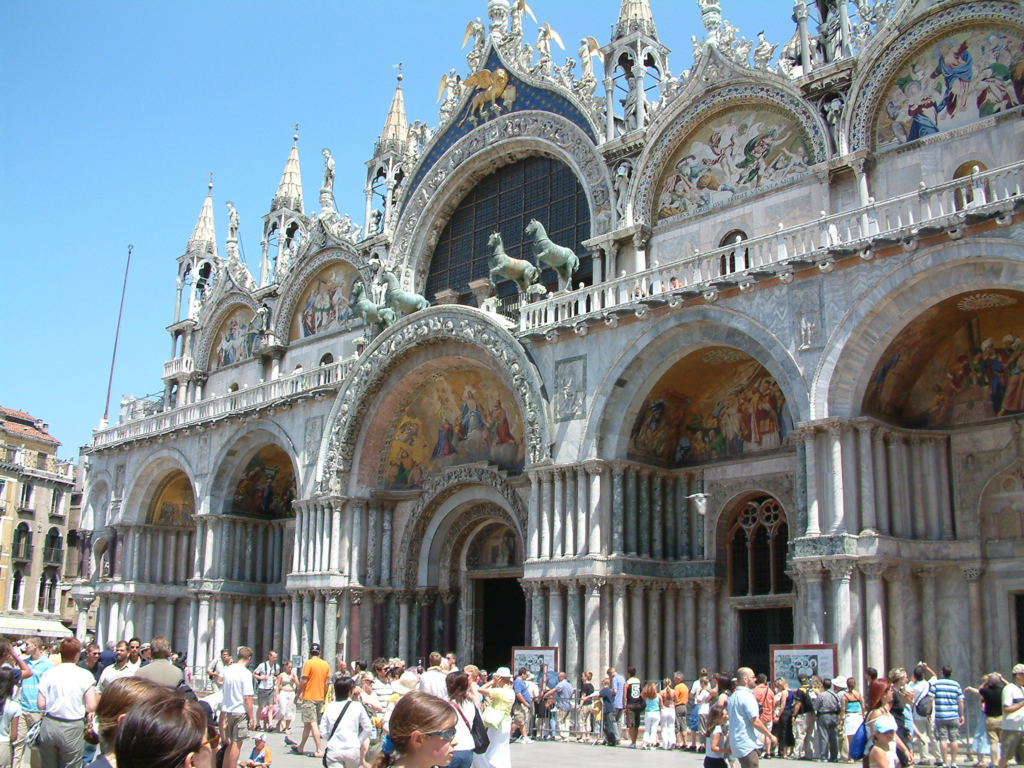
For centuries, rulers have recognized what these sculptures communicate without inscription: authority, continuity, and ambition. The Republic of Venice understood the value of symbols as clearly as it understood trade winds and naval routes. By claiming the quadriga, it claimed a lineage stretching back to antiquity.
In the end, the Horses of St. Mark are witnesses and silent observers of crusades, coronations, occupations, and restorations. Perched above the Piazza San Marco, they continue to reflect the audacity of the Republic of Venice, a state that mastered, apart from commerce and diplomacy, also the art of spectacle.


