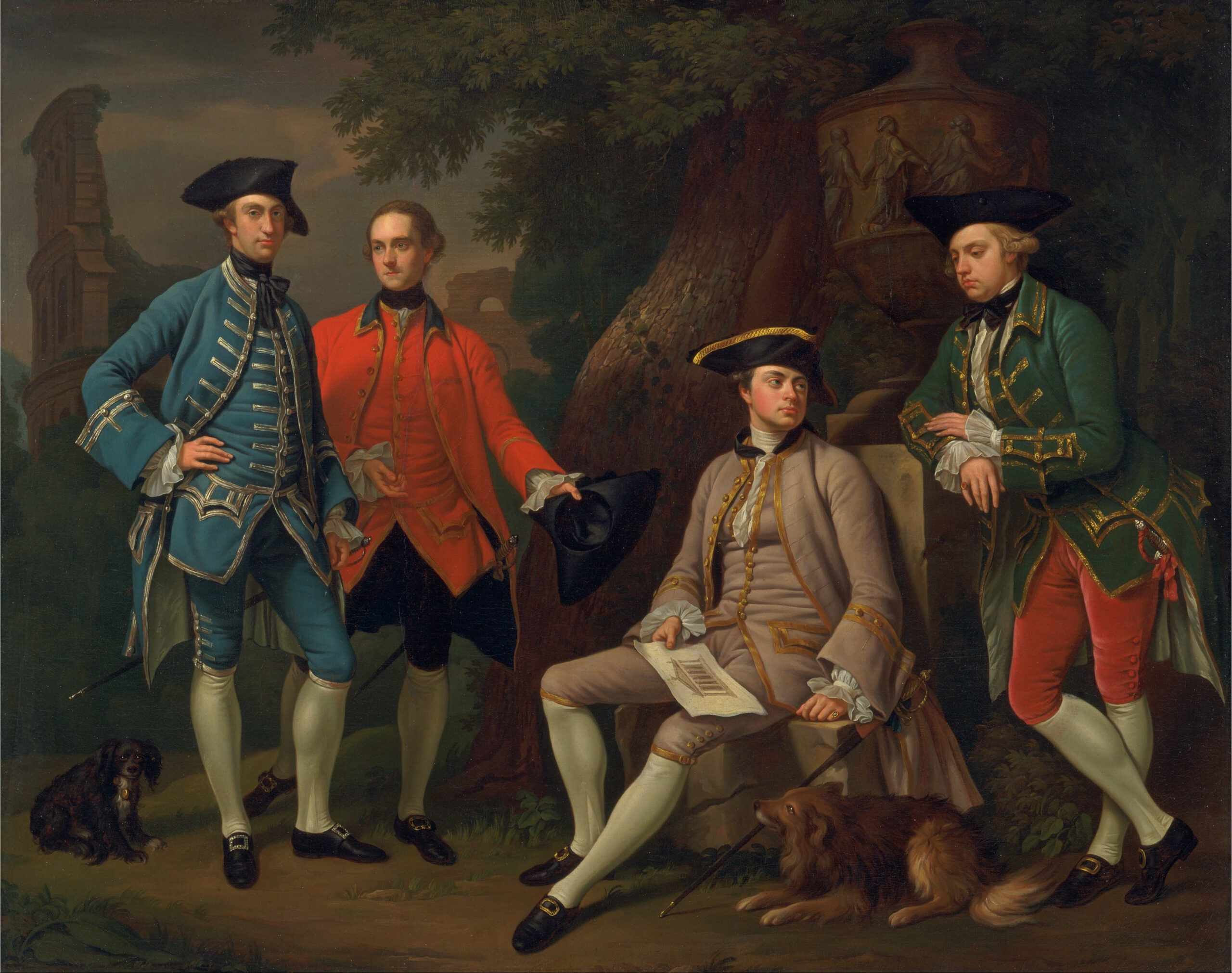
Gentlemen on the Grand Tour by Nathaniel Dance-Holland, c. 1760
In 1780, the Rev. Martin Sherlock, chaplain to the Earl of Bristol, man of letters, and restless wanderer across the continent, published Letters from an English Traveller, a slim but surprisingly sharp volume of correspondence written during his European tour. Addressed to aristocratic patrons back in England, the letters appeared to offer nothing more dangerous than polished commentary on art, manners, and scenery. But read carefully, the way a foreign ministry official might, and what emerges is something else entirely: a systematic, methodical account of cities, rulers, courts, and the temperament of peoples, packaged in the reassuring wrapping of gentlemanly curiosity. Sherlock was, in the parlance of a later age, performing informal reconnaissance.
The Grand Tour as Reconnaissance Operation
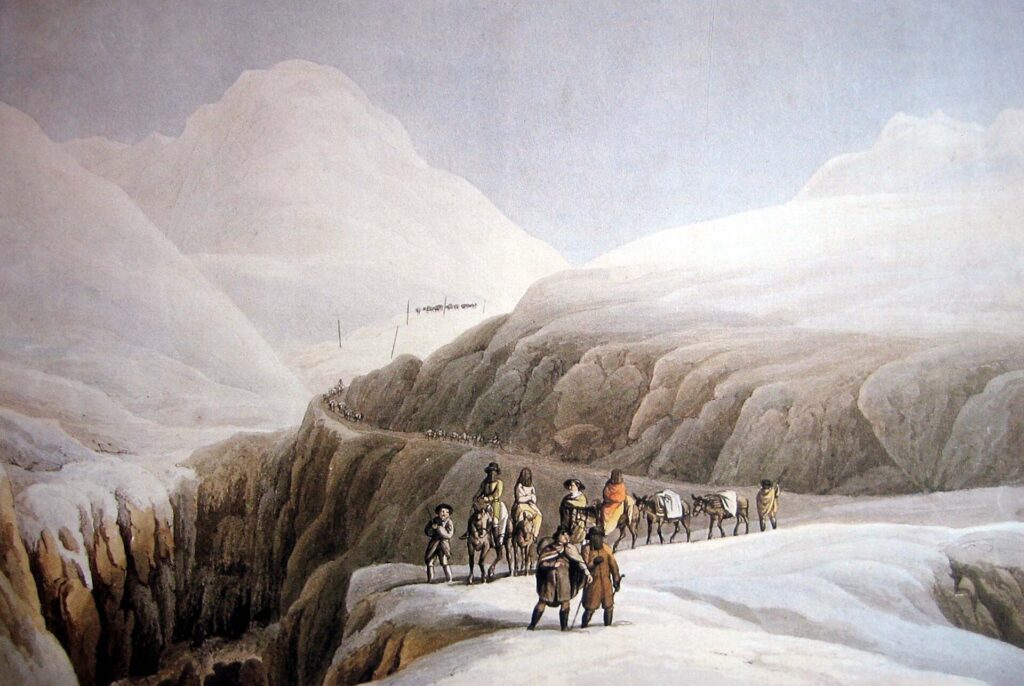
The 18th-century Grand Tour was Europe’s open secret. Young British aristocrats, diplomats-in-waiting, and educated clergymen crossed the Alps, drifted through Turin, Florence, Rome, and Vienna, and returned home transformed, culturally enriched and, crucially, informationally loaded. Their published travel accounts found eager audiences that stretched well beyond fashionable drawing rooms. Foreign ministers read them. Ambassadors annotated them. Heads of state received summaries of their contents.
Sherlock understood this dynamic intuitively. His opening letters read less like a tourist’s impressions and more like a briefing document. He was merely a curious Englishman, admiring palaces and commenting on opera. Nobody could accuse a clergyman of espionage for noting the width of a street or the morale of a populace.
Reading Courts Between the Lines
Sherlock’s letters from pages 17 through the close of Letter VI are studded with the kind of observations that any competent intelligence handler would have found invaluable. He remarks on the character of monarchs and ministers, not simply their grandeur, but their accessibility, their relationship with their subjects, the texture of their authority. He watches how courts present themselves and how the people respond.
“The King of Prussia is every where known as a great king, a great warrior, and a great politician; but he is not every where known as a great poet and a good man. Marcus Aurelius, Horace, Machiavel, and Cæsar, have been his models, and he has almost surpassed them all. I have never heard of a human being that was perfect; and this monarch also has his faults; but take him for all in all, he is the greatest man that ever existed.
At the beginning of his life he published his Anti-Machiavel, and this was one of the completest strokes of Machiavelism that ever he made. It was a letter of recommendation of himself that he wrote to Europe at the instant when he had formed the plan of seizing Silesia.
To his subjects he is the justest of sovereigns: to his neighbours he is the most dangerous of heroes; his neighbours shudder at him, his subjects adore him. The Prussians are proud of their Great Frederick, as they always style him. They speak of him with the utmost freedom, and at the same time that they criticise severely some of his tastes, they give him the highest elogiums. He was told that some one had spoken ill of him. He asked if that person had 100,000 men. He was answered, No. “Very well,” said the king, “I can do nothing; if he had 100,000 men, I would declare war against him.”
Of all the characters of the present age, that of this prince has been the most mistaken; and the reason is, that two parts of his character have been confounded, and only one judgment formed on two points, each of which requires a separate opinion. The King of Prussia has occasioned the death of some thousands of men; and the King of Prussia is a merciful, tender, and compassionate prince. This seems a contradiction; and it is a certain truth. He must first be considered as a conqueror, where it is not permitted to listen to the voice of humanity. When heroism is out of the question, we must examine the man. It will be said that this is a subtlety. I deny it, and appeal to history: What clemency more acknowledged than that of Julius Cæsar? What conqueror has shed more blood?”
BERLIN, OCT. 10, 1777.
These were not idle curiosities. In an era before formal diplomatic cables and professional intelligence networks, the cultivated traveler was often the most reliable source of soft intelligence a government could obtain. A man like Sherlock, moving freely through European capitals on the strength of his patrons’ names and his own charm, could go where an official representative could not, observe what a formal embassy would never be shown, and report back in a form that was publishable, plausible, and permanently archived.
The Letter Form as Intelligence Briefing
What makes Sherlock’s work so revelatory, seen through the lens of intelligence history, is his command of the letter format itself. The epistle, addressed to a named individual, written in the first person, organized around a journey, was ideally suited to the kind of selective, curated observation that reconnaissance demands. You report what you saw. You do not explain why you were looking so carefully.
His accounts of fortifications, court ceremonial, and civic infrastructure are delivered in the same breath as literary opinions and dinner invitations. What distinguishes Sherlock is how self-aware he seems about the dual nature of his enterprise. He writes with a precision that goes well beyond what picturesque description requires. He counts. He measures. He listens. He infers.
The “Tourist” as an Informal Intelligence Asset
Modern intelligence studies have a term for individuals who gather strategic information without formal state affiliation: the informal asset. They are not spies. They carry no dead drops, exchange no ciphers, draw no salary from a foreign ministry. But they move through politically sensitive environments with permission, gather information that agencies cannot easily collect through official channels, and transmit it in formats that are protected by cultural respectability.
Martin Sherlock was, in this sense, a textbook informal asset, probably without knowing it, or perhaps knowing it rather better than he let on. His patron, the Earl of Bristol, was a figure of considerable political importance. The audiences for these letters were not simply the reading public but the titled and ministerial classes who made foreign policy decisions. And Sherlock provided them with exactly the kind of granular, human-scale reconnaissance that formal diplomatic correspondence struggled to deliver.
He made this look like nothing more than an educated man enjoying his holiday. His readers held in their hands intelligence that was more useful than it appeared.
A Genre That Outlived Its Innocence
Travel writing never fully shed this intelligence function. The 18th century simply institutionalized it under the cover of culture, turning the Tour into a production line for strategic reconnaissance that governments were happy to read, patrons were happy to fund, and publishers were happy to print. Sherlock’s letters are among the most elegant surviving examples of the form: polished enough to be read at a salon, precise enough to be filed in a ministry, and, nearly two and a half centuries later, revealing enough to tell us that the line between the curious tourist and the attentive observer has always been thinner than either party preferred to admit.
