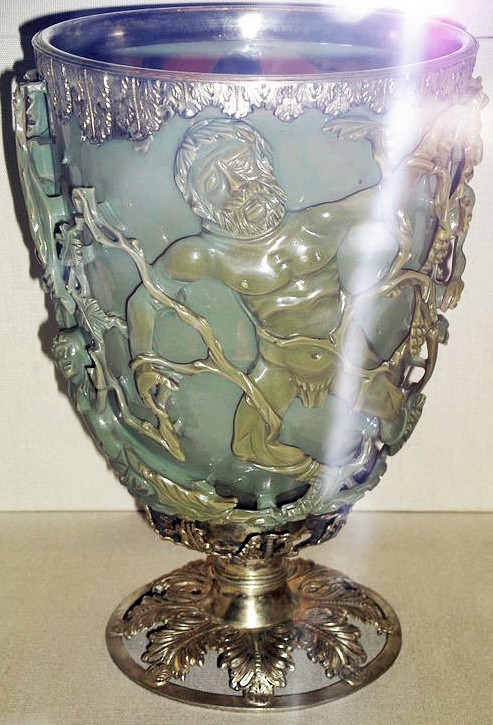
Drinking-cup, glass, green and red, covered with various scenes representing the death of King Lycurgus. British Museum. Photo by Dale Cruse from San Francisco, CA, USA. CC BY 2.0
Roman artisans cracked a technical problem in the 4th century that chemists wouldn’t fully understand until the 1990s. The Lycurgus Cup, the only complete example of its kind to survive antiquity, shifts from jade green to blood red depending on how light strikes it, a property so precise it implies deliberate engineering, not accident. The achievement signals that the line between ancient craft and modern materials science is far thinner than most people assume, and it explains why no one could reproduce the effect for a millennium and a half.
The mechanism, and the secrecy around it, are likely to keep fascinating scientists and historians for years to come. While the full story of who made the Lycurgus Cup and why remains incomplete, history and culture enthusiasts may find the object newly relevant: it’s a case study in how craft knowledge can outpace theoretical understanding by fifteen centuries.
What Makes the Lycurgus Cup Change Color
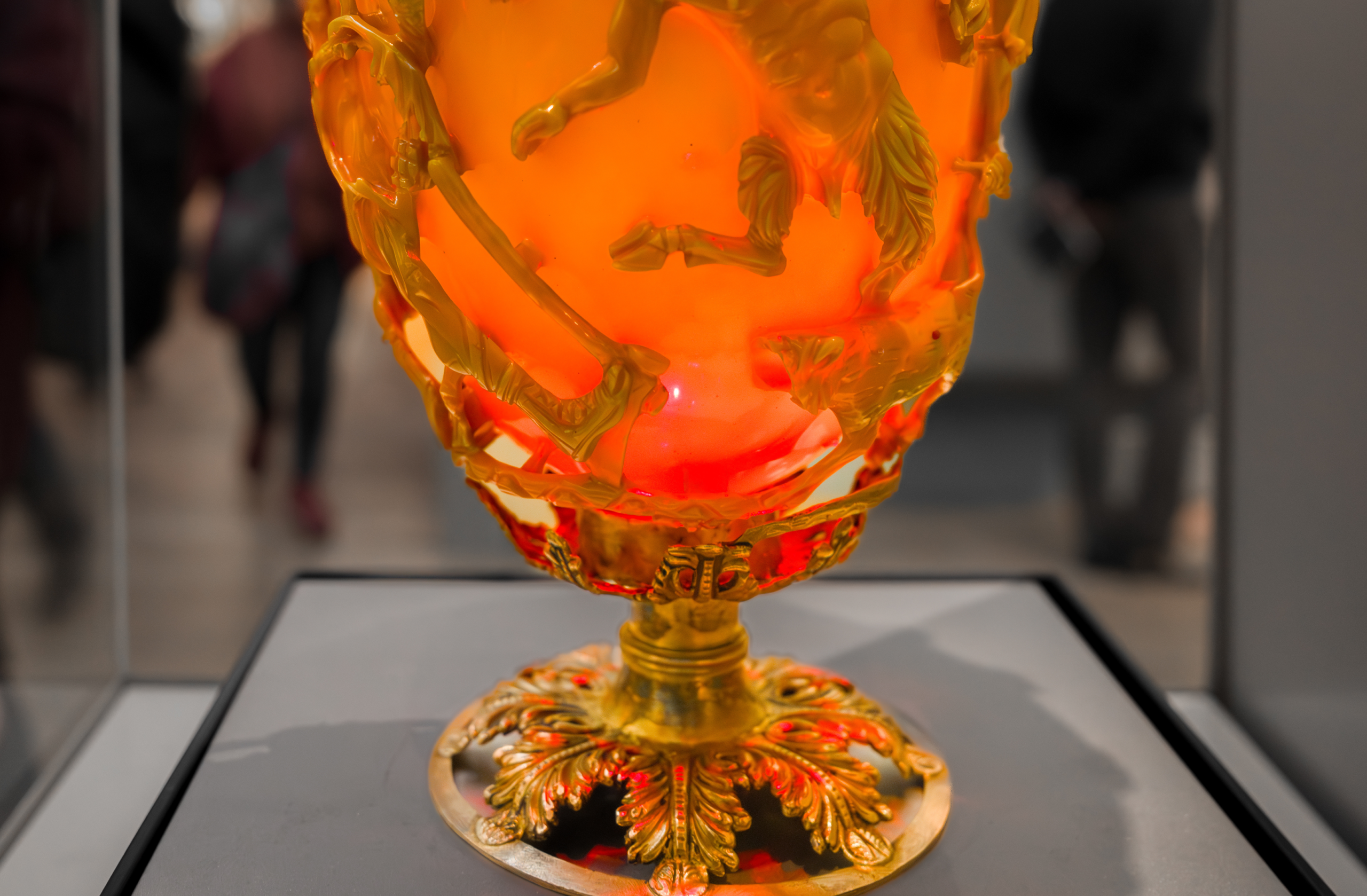
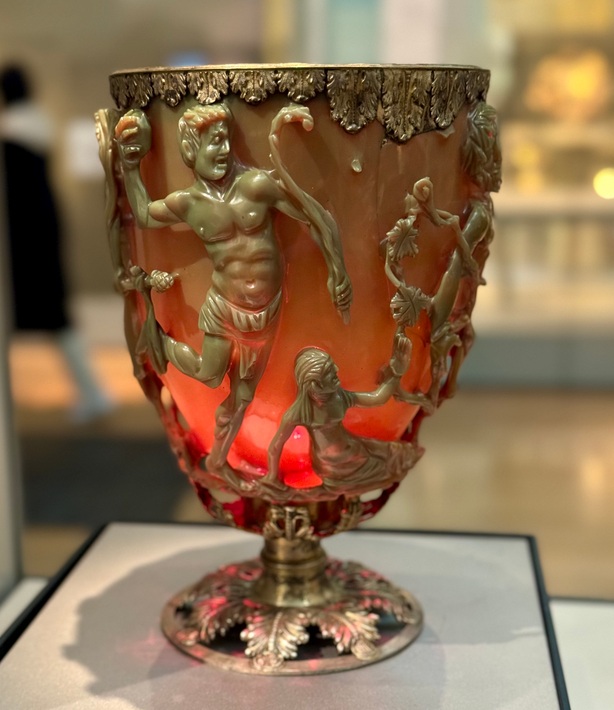
The cup looks opaque, olive-green when lit from the front. Held up to light passing through it, the same glass glows a deep, translucent red. This is dichroism. Literally “two-colored”, and the Lycurgus Cup is the only intact ancient vessel known to display it.
For decades, the effect puzzled curators and chemists alike. The mystery wasn’t solved until 1990, when researchers examined broken fragments of the cup under a microscope and found the Romans had laced the glass with metal at a scale invisible to the naked eye.
The Secret Was Gold and Silver, Ground Almost to Nothing
The glass of the Lycurgus Cup contains trace amounts of gold and silver, roughly a 7:3 ratio, with a small amount of copper, in the form of nanoparticles roughly 50 nanometers in diameter, less than one-thousandth the width of a grain of table salt. At that scale, metal stops behaving like metal. Electrons in the particles vibrate in response to light in a way that depends on the particle’s size and composition, a phenomenon physicists today call plasmon resonance. Silver nanoparticles in the cup produce the green reflected color, while gold nanoparticles generate the red that appears in transmitted light.
The craftsmen who made the Lycurgus Cup had no name for any of this. They were not aware they were using gold nanoparticles to produce ruby-colored glass, but this is exactly what they were doing by adding a small amount of chemically treated gold to the mixture. Whether the discovery began as an accident in a workshop where gold dust happened to mix with ground silver, or whether it was the product of careful experimentation, is still debated. What isn’t in question is the precision of the result: the ratio of gold to silver, and the size to which both were ground, fall within a narrow enough window that getting it wrong would have ruined the effect entirely.
Why “Forgotten” Is the Right Word
This is the detail that separates the Lycurgus Cup from most ancient marvels: the technique wasn’t lost to time so much as it was never written down, or never widely shared, and then it simply vanished. Only a handful of other small dichroic glass fragments have ever been found anywhere in the world, suggesting this was a rare, possibly closely guarded specialty rather than a common Roman workshop technique.
No medieval or Renaissance glassmaker managed to recover it. Stained glass artisans centuries later achieved rich reds using gold compounds, but the specific dual-metal, dual-color dichroic effect of the Lycurgus Cup went unmatched. The know-how required to grind both metals to the right particle size, in the right proportion, and disperse them evenly through molten glass without clumping or losing the effect simply disappeared along with whoever held it.
It would take the invention of the electron microscope, and a research team willing to sacrifice fragments of a priceless Roman antiquity to it, before anyone could explain what Roman hands had already mastered.
A Cultural Artifact
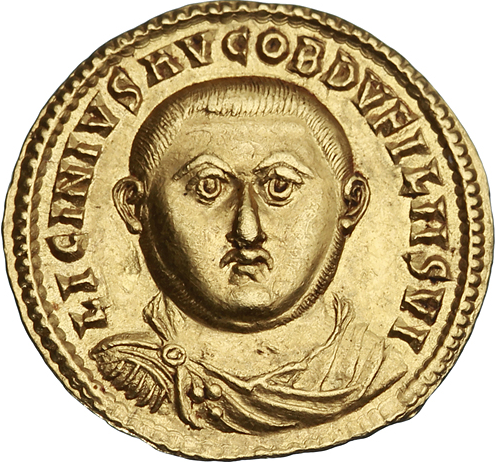
For those interested in the language of prestige objects, the Lycurgus Cup offers more than a chemistry lesson. This cup was a cage cup, or diatretum, made by casting a thick glass blank and then painstakingly cutting and grinding it away until figures stood in high relief, connected to the body of the vessel only by thin glass bridges. That labor-intensive technique alone marked an object as belonging to imperial or senatorial circles. The scene carved into the cup, Dionysus and his followers tormenting the Thracian king Lycurgus for his arrogance toward the gods, has been read by some historians as a political message, possibly referencing the defeat of the emperor Licinius by Constantine in AD 324. An object that could double as both a warning and a centerpiece would have made a formidable gift between men of power.
Where the Cup Sits Today
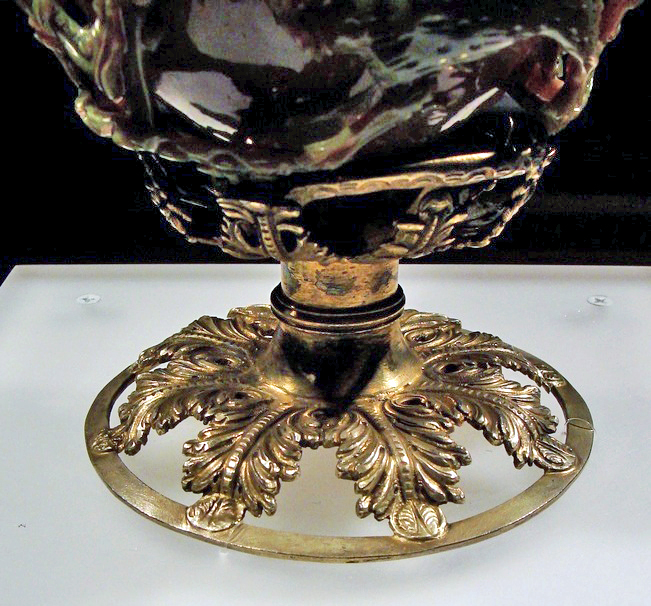
The Lycurgus Cup was purchased by the British Museum in 1958 from Victor, Lord Rothschild, and is now on permanent display in Room 41. Its earlier history is thin: the cup is first mentioned in print in 1845, and is thought to have been acquired by the Rothschild family shortly afterward, but its early history and find-spot remain unknown. Sixteen centuries after it was made, it remains the benchmark against which every attempt to recreate dichroic glass, including recent 3D-printing experiments using synthesized silver and gold nanoparticles, is still measured.

.jpg#/media/File:British_Museum_(53536948847).jpg)

.jpg#/media/File:Foot_of_Lycurgus_Cup_(British_Museum).jpg)
_A.jpg#/media/File:Photo_of_the_4th_c._CE_Lycurgus_Cup,_side_view_with_satyr,_British_Museum_(1958,1202.1)_A.jpg)
